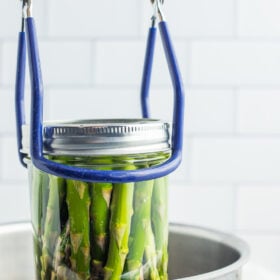
Canning Asparagus
Learn all about safely canning asparagus in a pressure canner. This is the perfect pressure canning recipe for new canners. You’ll love having jars of home-canned asparagus to extend the taste of spring all year long.
Servings: 7 pints
Ingredients
- 13 lbs asparagus
- 8 cups water {for jars}
- 3 quarts water {for canner}
- 4.5 tsp canning salt {optional}
Instructions
- Wash and clean your jars. Make sure they are preheated enough to not crack when placed in hot water.
- Wash your lids with hot soapy water and place them in a clean bowl.
- Trim asparagus to remove woody ends. Cut into smaller pieces or cut to fit the jar. Whole pieces should be 1-inch shorter than the inside of the jar.13 lbs asparagus
- (HOT PACK & COLD PACK INSTRUCTIONS) If you are hot packing, add the asparagus to a pot of boiling water for 2 minutes. If you are not hot packing, allow 8 (ish) cups of water to come to a boil in a pot or kettle.8 cups water
- Add 3 quarts of water to the pressure canner and put it on a burner set to high. Make sure there is a canning rack in the bottom of the canner.3 quarts water
- Add the asparagus spears/pieces to the sanitized jars. If adding salt, do that now. Gently tap the bottom of the jar on the counter a few times to pack the spears/pieces in there as well as possible.4.5 tsp canning salt
- Using a canning funnel, carefully and slowly add the clean boiling water from the kettle/pot, leaving 1-inch of headspace. Headspace is the distance between the top of the food and the top of the jar.
- Using a long utensil (I prefer a plastic chopstick), remove air bubbles from the jar.
- Clean the rim of the jar very well with a hot damp rag. Any food debris left on the rim may impact the seal of the lid in the canner.
- Place a clean lid on the jar. Add a ring, and tighten to fingertip tight.
- Using canning tongs, gently place the jars in the canner.
- Lock the lid. Soon, steam will start coming through the vent pipe. Allow the steam to pass through for about 10 minutes. Then put the pressure regulator on top.
- Pretty soon, the air vent will pop up.
- In a dial-gauge pressure canner, process pints and quarts based on the elevation guide below (see processing chart in post for altitude adjustments):*0-2,000f ft {PSI: 11 lbs of pressure} = Pints 30 min, Quarts 40 min*2,001-4,000k ft {PSI: 12 lbs of pressure} = Pints 30 min, Quarts 40 min*4,001-6,000k ft {PSI: 13 lbs of pressure} = Pints 30 min, Quarts 40 min*6,001-8,000k {PSI: 14 lbs of pressure} = Pints 30 min, Quarts 40 min
- When the dial gauge reaches the appropriate PSI, reduce the burner temp to medium, and start your timer. The pressure must stay at the PSI or (a little bit) above for the duration of the cooking time. You’ll likely need to adjust the temp on the burner a few times depending on your stove.
- When the time is up, remove the canner from the burner and allow it to sit until you hear a distinctive “click” of the air vent dropping. Remove the pressure regulator and carefully remove the lid of the canner (Pro tip: I always use oven mitts when I take the lid off because the steam is super hot).
- Let the jars sit for 5 minutes in the canner and then lift them out with canning tongs. Pro tip: allowing the jars to sit in the canner with the lid off can help reduce the siphoning of liquid in your jars.
- Remove with canning tongs and place on a towel where they can sit undisturbed for 12 hours.
- After a few hours, to check for sealing, gently press down in the middle of the lid. If the lid has no give, it’s sealed. If you can press the lid in and it pops a bit, your jars are not sealed.
Notes
Quarts: Salt (optional) 1 tsp
Pints: Salt (optional) 1/2 tsp
- If you don’t have a large batch of asparagus to can at once, you can process just a few jars if needed. It eventually does add up over the season! You need at least two jars in the canner to process the batch safely.
- Store in a cool dark place for 12-18 months.
Nutrition
Serving: 1pint | Calories: 117kcal | Carbohydrates: 23g | Protein: 13g | Fat: 1g | Saturated Fat: 0.2g | Polyunsaturated Fat: 0.3g | Sodium: 45mg | Potassium: 1178mg | Fiber: 12g | Sugar: 11g | Vitamin A: 4409IU | Vitamin C: 33mg | Calcium: 160mg | Iron: 12mg