
As an Amazon Associate, I earn from qualifying purchases.
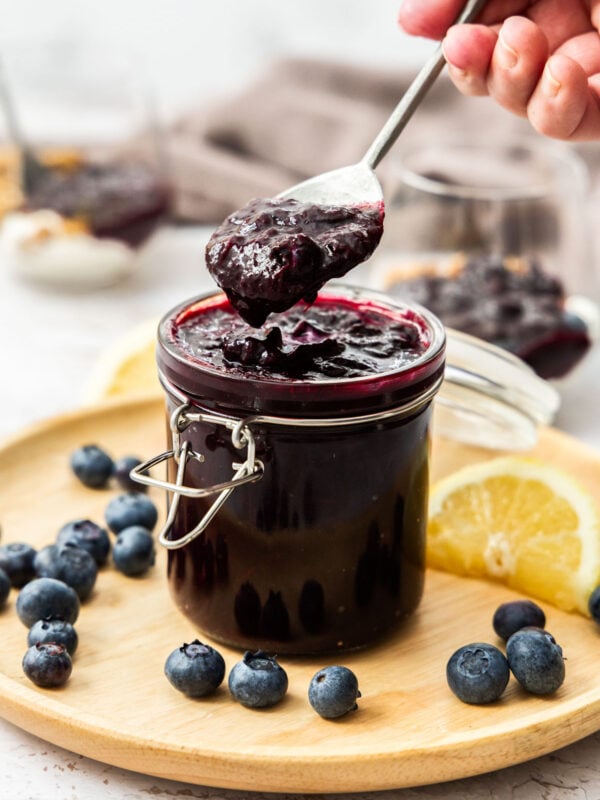
An easy step-by-step tutorial on canning blueberries. This recipe for how to preserve blueberries is perfect for beginners and experienced canners alike. Instructions include low-sugar and no-sugar options.

I have great news for you! Blueberries are one of the easiest fruits to can. And they’re also delicious, so we have that going for us.
And as if life couldn’t get better, I’m going to teach you how to make canned blueberries in a light syrup so you can actually taste the fruit, not just sugar. Need no-added-sugar options? We’ve got them!
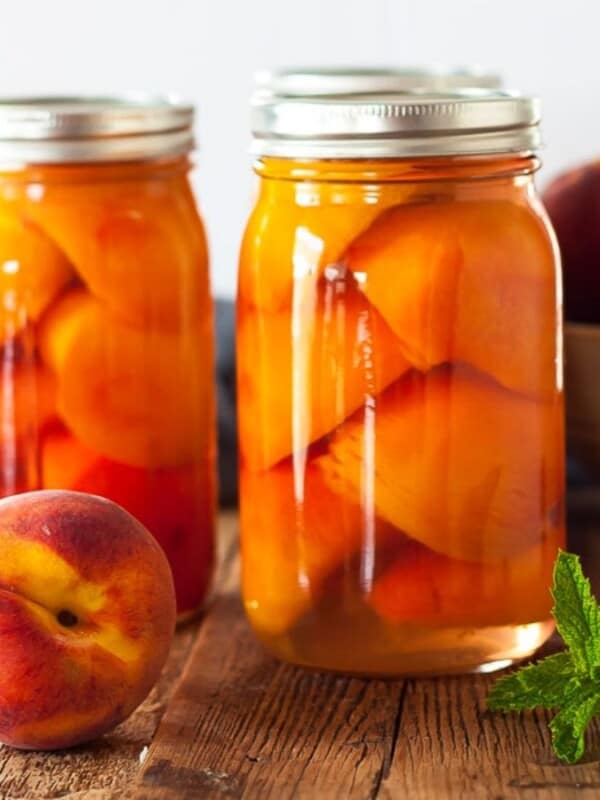
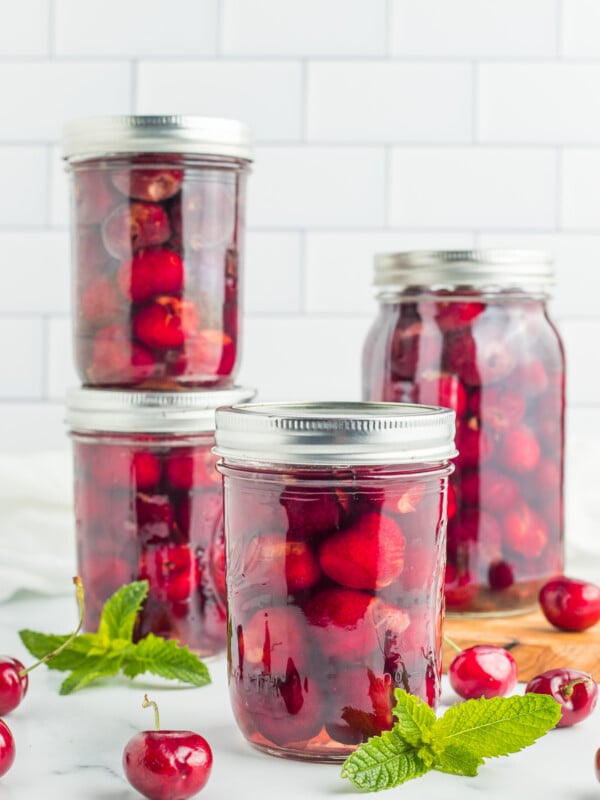
After trying this recipe, you’ll want to can the other stars of summer produce – peaches and cherries! Check out our tutorial on canning peaches and canning cherries for step-by-step guides on preserving those tasty fruits.
How to can blueberries
*I’ll walk you through it here with some photos and tips, and you’ll also find a printable recipe card at the bottom of the post with exact measurements, etc. You can also click “jump to recipe” to skip down.
Canning prep
Prepare your water bath canner by filling it with water. You need to have enough water to cover the jars by 1 inch once the water is boiling.
Set the canner on the stove. Turn the burner to high. Once it reaches a boil, reduce it to a simmer. You want to keep the water hot so that everything is ready when the fruit is.
Wash and clean your jars. You’ll want to keep them warm to avoid having them crack when placed in the canner. You can fill them with hot water, or place them on a tray in the oven at 170˚F.
Wash your lids and set them aside in a clean place. You no longer need to simmer lids in water to keep them sterile. Woot!
An average of 12 pounds is needed per canner load of 7 quarts; an average of 8 pounds is needed per canner load of 9 pints. If you don’t have a large batch of blueberries to can at once, you can process just a few jars if needed. It eventually does add up over the season!
Rinse the blueberries, removing stems and blossom ends (those weird looking little brown dried leaf-like things).
Next up, let’s prep the syrup! <—-that exclamation point is meant to get you freaking stoked. Did it work?
Syrups for canning
If you prefer a no-sugar option, berries can be canned using only water. But if you plan to can your blueberries with sweetener, you can use sugar, honey, or fruit juice (apple or white grape).
See the cheatsheet below as a guideline for making syrup:
Syrups for Canning
| Syrups for Canning | ||||
| Type of Syrup | Sweetener | Amount of Sweetener | Water | Yield |
| Very light | Sugar | 1 cup | 6 cups | 5 3/4 cups |
| Light | Sugar | 2 1/4 cups | 5 1/4 cups | 6 1/2 cups |
| Medium | Sugar | 3 1/4 cups | 5 cups | 7 cups |
| Heavy | Sugar | 4 cups | 5 cups | 7 cups |
| Honey | Honey | 1 cup | 4 cups | 4 1/4 cups |
| Juice | Apple or white juice concentrate | 1 1/2 cups | 4 1/2 cups | 6 cups |
| *Source: National Center For Home Food Preservation | ||||
Pro tip: if you plan to process multiple batches of blueberries in a day, make the syrup and transfer it to a slower cooker set to “high”. This will keep the syrup hot while freeing up space on your stove.
Raw Packing Blueberries
Raw packing simply means placing the fruit in the jars without pre-cooking them, filling the jars with hot syrup (or water), and processing them in the canner.
Raw packing is generally faster than then a hot packing process, but there are some drawbacks. No matter how well you pack the jars, the density of the fruit will change during their time in the canner.
This often leads to something called “fruit float” in which the fruit will float to the top of the jar, leaving all syrup on the bottom. There is nothing wrong with fruit float as long as your jars are still sealed.
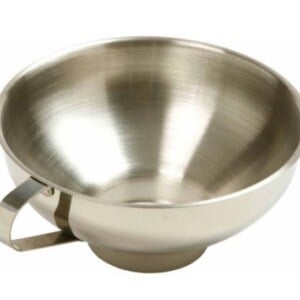
To raw pack the blueberries, using a canning funnel and a ladle, fill each jar with drained blueberries. Tap and shake the jar down, and add ~1/2 cup of hot syrup/water.
Continue to add blueberries and syrup until the jar is full and there is 1/2 inch of headspace at the top of the jar.
Hot Packing blueberries
Hot packing involves cooking the blueberries briefly in boiling water before packing the fruit into jars for canning.
Fill a large heavy-bottomed saucepan (I used my enameled Dutch Oven), half-full with water. Bring to a boil. Add the blueberries, cook for 30 seconds, and then drain.
Pro tip: If you’re doing multiple batches, use a skimmer or a slotted spoon to remove the blueberries from the boiling water. That way you don’t have to wait for water to come back to a boil before adding more berries.

Using a canning funnel, ladle the drained blueberries and syrup into your jars until the jars are full and there is 1/2 inch of headspace. Using a long utensil (I prefer a plastic chopstick), remove all the air bubbles from the jar.

Clean the rim of the jar very well with a hot damp rag. Place a new, clean lid on the jar. Add a ring, and tighten to fingertip tight.

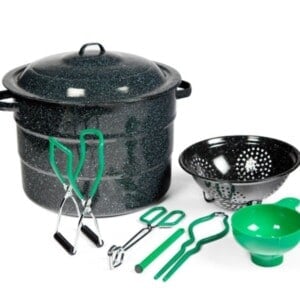
Using canning tongs, add your jars to the boiling water, and put the canner lid on. Pro tip: you must have at least 1 inch of water over the tops of the jars for safe canning. Processing times will vary based on altitude. See the chart below.
Water Bath Processing Time for Blueberries
| Processing Time for Blueberries | |||||
| Process Times at Altitudes of: | |||||
| Style of Pack | Jar Size | 0-1,000 ft | 1,001-3,000 ft | 3,001-6,000 ft | Aove 6,000 ft |
| Raw | Pints | 15 min | 20 min | 20 min | 25 min |
| Quarts | 20 min | 25 min | 30 min | 35 min | |
| Hot | Pints or Quarts | 15 min | 20 min | 20 min | 25 min |
| *Source: National Center For Home Food Preservation | |||||
Once the jars have been processed for the appropriate amount of time, remove the canner from the burner, wearing oven mitts carefully take off the lid of the canner, and allow the jars to sit in the canner for 5 minutes. Pro tip: I tend to just slide the canner into the middle of my stove, as it weighs a ton.
Carefully remove the jars with canning tongs, and place them on a thick towel in a place where they can be undisturbed for 12 hours.

The lids will likely start to pop within 20-30 minutes of being removed from the water. That popping sound is music to your ears, as it tells you that everything has been sealed. It’s a reward for all your work!
After the jars have rested for about 12 hours, press down in the middle of each lid. If it “gives” at all, the jar didn’t seal. Either enjoy it that day, put it in the fridge, or reprocess it using a new lid.
Get my Canning e-book!
It’s 51 pages of every helpful tip and trick you could want as a brand new canner, AND it includes 13 ad-free canning recipes that are designed to take you from novice to pro.

Canning Blueberries
Equipment
Ingredients
- 8 lbs blueberries
- 6 cups water {+more for the canner}
- 1 cup sugar {optional}
Instructions
Canning Prep
- Prepare your water bath canner by filling it with water. You just need to have enough water to cover the jars by 1 inch once the water is boiling.
- Set the canner on the stove. Turn the burner to high. Once it reaches a boil, reduce it to a simmer. You want to keep the water hot so that everything is ready when the blueberries are.
- Wash and sanitize your jars. You’ll want to keep them warm to avoid having them crack when placed in the canner. You can fill them with hot water, or place them on a tray in the oven at 170˚F.
- Wash your lids and set aside in clean place.
- Rinse the blueberries, removing stems and blossom ends (small brown leaves).8 lbs blueberries
- {optional} If you are canning the blueberries with syrup, make that now. Combine water and sugar in a medium saucepan, and cook over medium heat until the sugar has dissolved.6 cups water, 1 cup sugar
Canning Blueberries
- (Hot Pack Option) Fill a large heavy-bottomed saucepan, half-full with water. Bring to a boil. Add the blueberries, cook for 30 seconds, and then drain.
- (Hot Pack Option) Using a canning funnel, ladle the drained blueberries and syrup into your jars until the jars are full and there is 1/2 inch of headspace. Tap the jars a few times during the filling process.
- (Raw Pack Option) To raw pack the blueberries, using a canning funnel and a ladle, fill each jar with drained blueberries.
- (Raw Pack Option) Tap and shake the jar down, and add ~1/2 cup of hot syrup/water.
- At this point, return your water in the canner back to a rolling boil.
- Using a long utensil (I prefer a plastic chopstick), remove all the air bubbles from the jar.
- Clean the rim of the jar very well with a hot damp rag.
- Place a new, clean lid on the jar. Add a ring, and tighten to fingertip tight.
- Using canning tongs, gently place your jars in the canner. Put the lid on, and set your timer. Pro tip: the water must return to a boil in the canner before you can start the timer.
- Process HOT PACK pints and quarts based on the elevation guide below:*0-1,000 ft – Pints & Quarts =15 min *1,001-3,000 ft – Pints & Quarts =20 min *3,001-6,000 ft – Pints & Quarts =20 min *6,000 ft+ – Pints & Quarts =25 min
- Process RAW PACK pints and quarts based on the elevation guide below:*0-1,000 ft – Pints =15 min Quarts =20 min*1,001-3,000 ft – Pints =20 min Quarts =25 min*3,001-6,000 ft – Pints =20 min Quarts =30 min*6,000 ft+ – Pints =25 min Quarts =35 min
- Once the blueberries have processed for the appropriate amount of time, remove the canner from the burner, and carefully remove the lid of the canner (Pro tip: use oven mitts to take the lid off because the steam is super hot).
- Let the jars rest in the canner (without its lid) for 5 minutes.
- Using canning tongs, carefully remove the jars, and place them on a thick towel in a place where they can be undisturbed for 12 hours.
- After the jars have rested for about 12 hours, press down in the middle of each lid. If it "gives" at all, the jar didn't seal. Either enjoy it that day, put it in the fridge, or reprocess it.
Notes
- If you’re planning to can multiple batches of blueberries all at once, I use my crockpot to create and keep the syrup hot. It frees up space on the stove.
- Once the jars have sealed, remove the rings. Label and store sealed jars in a cool (best results are 50-70˚F) dark place for up to 12-18 months.
Nutrition
Nutrition information is automatically calculated, so should only be used as an approximation.